
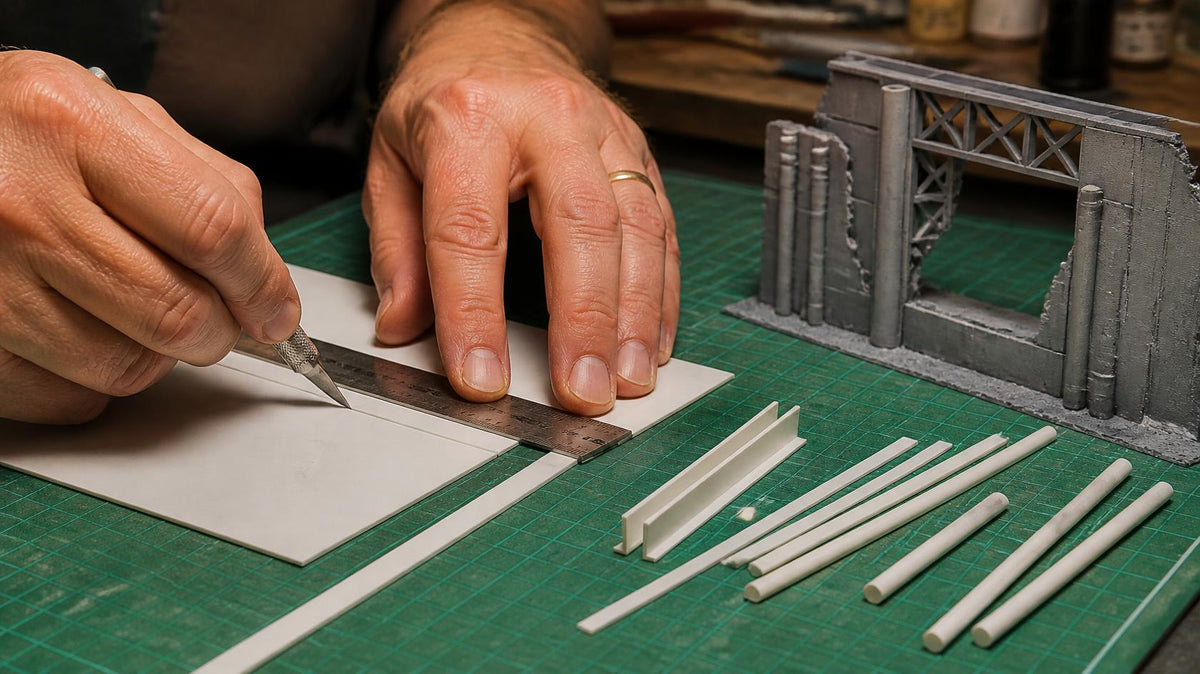
If you've walked past the Evergreen rack in our Townsville shop and wondered what all those packets of white plastic are for, this one's for you.
Evergreen makes polystyrene, the same plastic most model kits are moulded from, in flat sheets, strips, rods, tubes and structural shapes. Modellers use it to build things that don't come in a box: terrain, buildings, conversions, vehicle details and repairs. It's cheap, easy to cut, and glues together with ordinary plastic cement.
What's in the Range
| Type | What it is | Use it for |
|---|---|---|
| Plain sheet | Flat sheets in different thicknesses | Walls, floors, armour plates, panels |
| Textured sheet | Sheets moulded with siding, planks or grooves | Building walls, wooden floors, model railway structures |
| Strip | Rectangular strips | Trim, framing, planks, edging |
| Rod and tube | Round solid rods and hollow tubes | Pipes, barrels, railings, pins |
| Shapes | I-beam, T-shape, Z-channel, angle and more | Girders, frameworks, industrial detail |
You'll find products like clapboard siding, V-groove siding, I-beams and T-shapes in our full Evergreen range. Each product number refers to a specific profile and size, so once you find one you like, it's easy to buy the same again.
Tools You'll Need
- A sharp hobby knife. Fresh blades make a huge difference with styrene.
- A cutting mat, ideally with a grid for measuring and squaring.
- A metal ruler to guide your cuts.
- Plastic cement such as Icky Sticky Extra Thin Cement.
- Sanding sponges like the Warhaus Sanding Sponge for cleaning up edges.
- Sprue cutters for quickly cutting strip and rod. See our first wargame checklist for options.
How to Cut It: Score and Snap
You don't need to cut all the way through styrene sheet.
- Line up your metal ruler on the cut line.
- Score along it with your knife, using light pressure. Two or three passes is enough.
- Bend the sheet along the score line and it snaps cleanly.
- Tidy the edge with a sanding sponge.
Thicker sheet just needs a few more passes before it snaps. Strip, rod and shapes cut easily with a knife or clippers.
How to Glue It
Thin liquid cement is the best glue for styrene. It doesn't sit between the parts like super glue. It softens the plastic on both sides and welds them into one piece.
- Hold the two parts together exactly where you want them.
- Touch the brush of liquid cement to the join. It runs along the seam by itself.
- Hold for a few seconds, then leave it to harden fully before handling.
Ideas to Get You Started
- Terrain. Plain sheet and I-beams make industrial walkways and ruined buildings. Combine them with 3D printed terrain for details your printer can't do as cleanly.
- Bases. Thin strip makes planks, broken floors and debris. See our basing guide.
- Conversions. Add armour plates, rebuild a damaged part, or fill gaps.
- Model railways and dioramas. Textured siding is made for buildings, platforms and sheds.
- Scale model detailing. Rod and tube make aerials, pipes and gun barrels.
Painting Styrene
Wash off any finger grease, prime it, and paint it like any other plastic model. It takes primer and paint very well. Weathering is a great way to make scratch-built pieces sit naturally next to kit parts. Our weathering guide covers the basics.
See the Rack
The full Evergreen rack lives in our shop at 22 Castlemaine Street, Kirwan, and it's much easier to pick sizes when you can see and feel them. Or browse the whole Evergreen range online.