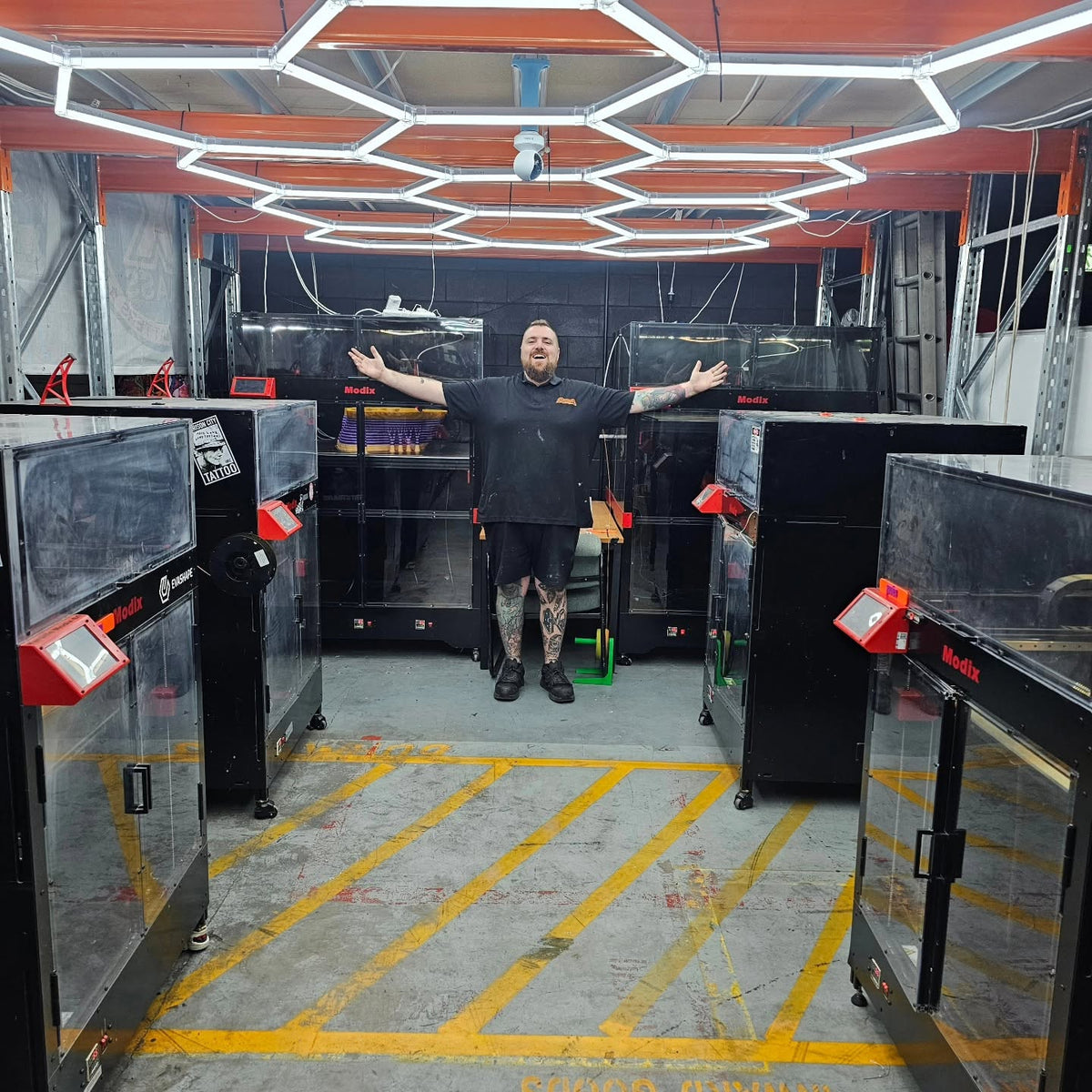
People who come into the shop for drone parts or paint are often surprised by what's out the back. Behind the counter at 22 Castlemaine Street, Kirwan, is a working fabrication workshop with around 50 3D printers, three lasers and a lot more besides. It's where we make everything from tiny FPV mounts to a life-size dragon.
We get asked "can you make this?" a lot, and the honest answer usually depends on which machine is right for the job. So here's a tour of what we've got and what each one is best at.
At a Glance
| Machine | What it does best |
|---|---|
| Modix Big Meter and Big 60 V3 | Very large prints: props, statues, installations |
| Prusa XL | Large multi-material and multi-colour prints |
| Prusa Core One and Core One L | Enclosed printing of tougher engineering materials |
| Bambu Lab and Snapmaker printers | Fast, reliable everyday prints and production runs |
| Resin printers | Fine detail: miniatures, masters for moulds, small parts |
| 3D scanner | Turning a real object into a 3D file |
| xTool F2 Ultra with UV | Marking and engraving metal, glass and delicate materials |
| Thunder Laser Aurora Lite | Fine engraving, including coated and anodised metal |
| LZRMN 6040 80W CO₂ laser | Cutting wood and acrylic, larger engraving jobs |
| Vaquform DT2 | Vacuum forming thin plastic shells |
| Casting setup | Silicone moulds and resin copies |
Large-Format 3D Printing: Modix Big Meter and Big 60 V3
These are the machines that surprise people most. The Modix printers have build volumes measured in hundreds of millimetres per side, with the Big Meter reaching around a metre, so they can print parts most desktop printers would need to split into dozens of pieces.
They're behind our biggest projects: the life-size Toothless and the giant crabs in our Tide Walkers installation. They're also the right tool for cosplay armour, large props, signage, display pieces, mascots and big prototypes.
The trade-off is time. A single large part can take days to print, so they're for jobs where size matters most.
Prusa XL: Big and Multi-Material
The Prusa XL is a large-format desktop printer with multiple toolheads, which means it can print more than one material or colour in a single job without the waste of constant filament swaps.
That's handy for parts that combine a rigid body with flexible sections, such as PETG with TPU, and for multi-colour display pieces. It's a great middle ground between the giant Modix machines and everyday printers.
Prusa Core One and Core One L: Engineering Materials
The Core One printers are fully enclosed, which keeps the heat in and the draughts out. That matters for tougher materials like ASA, which warp and crack on an open printer. The Core One L is the larger version, so we can print bigger parts in the same tough materials.
They're what we reach for when a part needs to survive heat, sun or real mechanical load: outdoor fittings, car parts, brackets and functional components. If you're printing parts for a drone, our guide to printing your own FPV parts explains which materials to use where.
Bambu Lab and Snapmaker: The Print Farm
Most print-on-demand jobs run across our fleet of Bambu Lab and Snapmaker printers. They're fast, consistent and easy to keep running, which makes them ideal for small and medium parts, replacement pieces, multi-colour prints and production runs.
With around 50 printers in the workshop, we can split a big order across many machines at once. A run of a hundred parts doesn't have to wait for one printer to churn through them one by one.
Resin Printers: Fine Detail
When detail matters more than size or toughness, resin is the answer. Our resin printers produce smooth surfaces with almost no visible layer lines, which makes them perfect for miniatures, jewellery-style pieces, small display items and masters for moulding.
Resin prints need washing, curing and careful cleanup, which we do in-house. If you're painting your own, our guide to painting 3D prints covers the prep.
3D Scanner: From Object to File
Sometimes the starting point isn't a file, it's a thing. A broken part, an heirloom, a sculpture or a body panel. Our 3D scanner captures the shape of a real object as a 3D model, which we can then clean up, modify, print, or use to make a mould.
We've used it on everything from replacement parts to a turtle skull we later printed for Tide Walkers. Pair it with our CAD design service if the scanned part needs changes before it's made.
Laser Cutting, Engraving and Marking
We run three lasers, and each does a different job. Details for the cutting and engraving service are on our laser cutting and engraving listing.
xTool F2 Ultra with UV
Our newest laser combines a 60W MOPA fibre laser and a 40W diode laser, with a 5W UV laser alongside. The MOPA laser is made for marking metal. Because its pulses can be finely tuned, it can produce crisp, permanent marks on steel, aluminium and other metals, and even colour marks on stainless steel.
The UV laser is a "cold" laser that marks without much heat, which makes it the right choice for glass and for delicate or heat-sensitive materials that other lasers would scorch or crack. Think engraved glassware, serial numbers and logos on tools and parts, branded metal tags and fine personalised gifts.
Thunder Laser Aurora Lite
A compact machine for fine, precise engraving on wood, leather, acrylic, slate, coated mugs and painted, powder-coated or anodised metals. It's quick to set up for small jobs like tags, plaques and personalised items.
LZRMN 6040 80W CO₂ Laser
The big cutter. The LZRMN 6040 is a cabinet-style 80W CO₂ laser with a 600 × 400 mm bed, built on linear rails for accurate, repeatable cuts. It cuts plywood and MDF up to around 12 mm and acrylic up to around 8–10 mm, plus natural timber, leather, fabric, foam, paper and card. It also engraves timber, leather, acrylic, glass, anodised aluminium and painted or coated surfaces.
It's the one for signs, panels, enclosures, templates, stencils and anything flat that needs cutting cleanly and repeatably, from a single piece to a full batch.
We don't laser PVC or polycarbonate, which give off toxic fumes, and our lasers are for marking and engraving metal rather than cutting through thick metal plate.
Vaquform DT2: Vacuum Forming
The Vaquform DT2 heats a sheet of plastic and pulls it over a shape with suction, producing a thin, lightweight shell. It has a 250 × 200 mm forming area and handles sheet from 0.3 to 3 mm thick in materials like PETG, ABS and HIPS.
It's ideal for FPV canopies, cosplay helmets and armour, packaging inserts, trays and product housings. We often 3D print the shape it forms over, so the two machines work as a team.
Moulding and Casting
For copies of a part, we make a silicone mould from a master, then cast copies in resin. Our casting gear includes a vacuum chamber for degassing silicone and a pressure pot for curing resin, which together get rid of the air bubbles that ruin a casting.
The result is solid, bubble-free parts with no layer lines, from one-offs to short runs. We used the same process for the glowing eggs in Tide Walkers.
The Finishing Bench
Machines make parts. Finishing makes them look good. Alongside the big machines we do sanding, filling, plastic welding to join large printed sections, and airbrush painting with a proper compressor. That's how a stack of printed pieces becomes a finished prop. We use the same paints and airbrushes we sell.
How the Machines Work Together
Most interesting jobs use more than one machine:
- Scan, print, cast: scan an original, print a clean master, then mould and cast copies.
- Print, vacuum form: print a buck and form a batch of identical shells over it.
- Print and mark: print a part, then laser-mark a logo or serial number onto a metal plate or tag that goes with it.
- Laser and print: laser-cut flat panels and print the brackets and joins.
- Print, weld, paint: print big sections on the Modix machines, weld them together and airbrush the finish.
If you're not sure which process suits your project, our guide to choosing between 3D printing, casting, vacuum forming and laser cutting walks through it.
Got Something to Make?
Upload a file for a 3D printing quote through Rising Sun 3D, or see our workshop services for moulding, casting, vacuum forming and laser work. You can also call us on 0440 130 405, or bring your idea into the shop at 22 Castlemaine Street, Kirwan. We're always happy to show people around.